
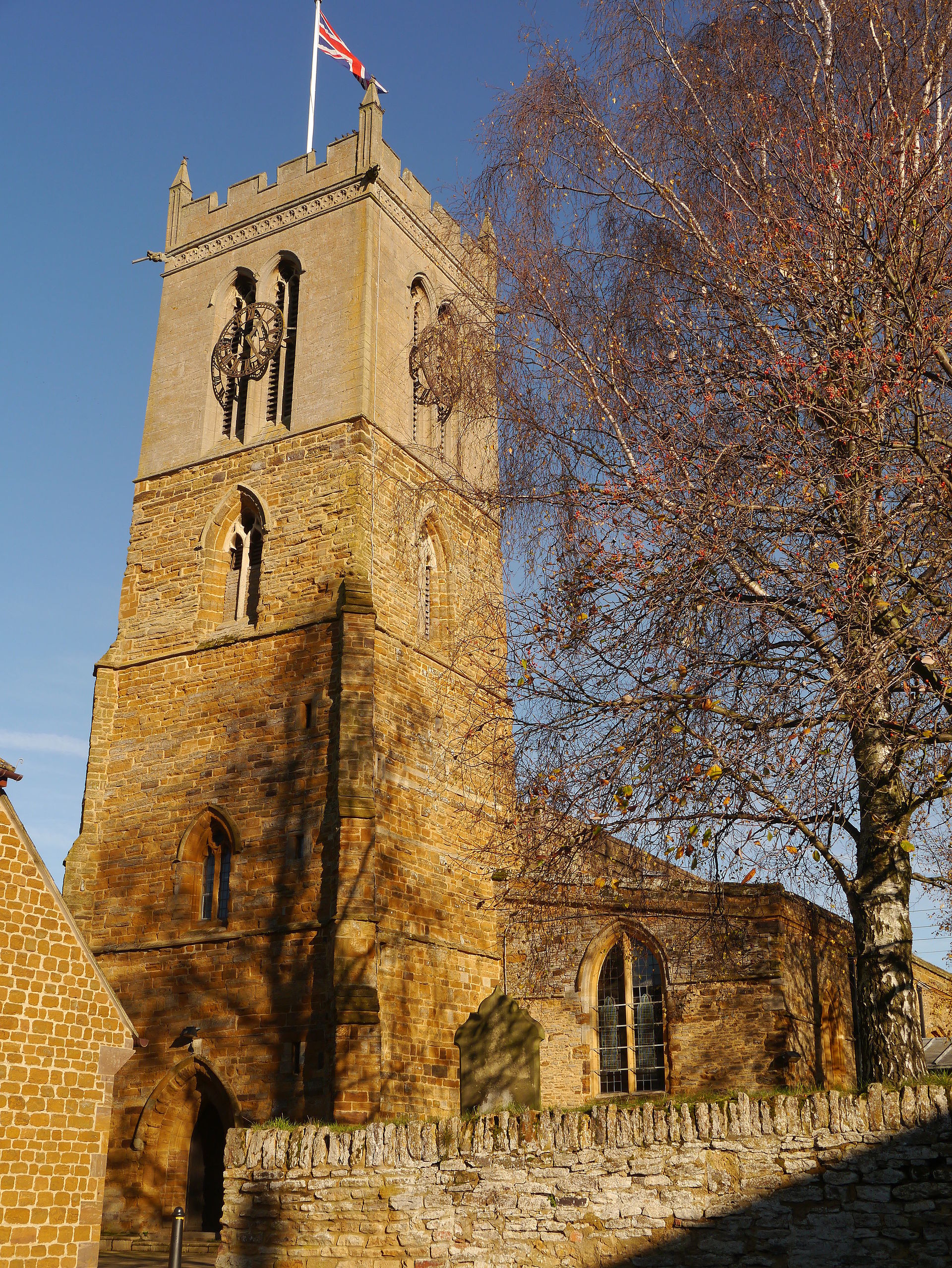
St Peter
Weston Favell, Northamptonshire
St Peters is a small church of ancient beginnings with various adaptations over the centuries.

Norman Grade 1 listed building, with 12 regularly rung bells, with some Saxon artifacts. The building has numerous changes in layout, formation and size since it was built.
Moulton, Northamptonshire
St Peter & St Paul stands as a vivid chronicle of medieval and later building traditions in Northamptonshire. Its mixture of Norman remnants, early Gothic innovation, and later adaptations, combined with its unusual architectural puzzles and fine historic furnishings, make it an essential stop for enthusiasts of English parish churches. Rising from the heart of the village, it is one of Northamptonshire’s most architecturally intriguing parish churches. Built largely of warm ironstone and lias, it reflects almost a thousand years of continuous worship and architectural evolution, from its Norman origins to later medieval and post‑medieval additions.
The church began as an aisleless Norman nave, a fragment of whose original window arch remains visible inside the building. Around the late 12th century, a north aisle was added, its arcade distinguished by low square piers with four demi‑shafts and simple round arches. A major phase of rebuilding occurred around 1300, when the church was substantially enlarged. The south arcade with its octagonal piers dates to this period, as do numerous windows featuring Y‑tracery and intersecting tracery, together with the arches to the north and south chapels. At the west end rises a four‑stage tower, mainly Decorated in style but with a later Perpendicular ashlar‑faced top storey, complete with two‑light bell openings, quatrefoil frieze and battlements. Within the tower are hung 12 bells. The tower once supported a spire, removed or collapsed in 1702.
Internally, the church is noted for a long‑debated architectural curiosity: two tall masonry plinths beneath the north arcade, one circular and one octagonal. Their purpose is unknown, though they may be remnants of post‑medieval alterations or structural repairs, possibly following damage when the spire fell. Their irregularity continues to puzzle architectural historians.
Visitors will find a rich collection of furnishings and historic fragments, together, these features illustrate the long devotional and artistic history of the church:
The churchyard contains several Grade II listed 18th century chest tombs, each contributing to the historic setting. These monuments are protected both for their individual craftsmanship and their group value with the church:
Weston Favell, Northamptonshire
St Peters is a small church of ancient beginnings with various adaptations over the centuries.
Kingsley, Northamptonshire
The creation of this outstanding late Victorian Gothic church was made possible by its patron the local brewer Pickering Phipps, the local architect Matthew Henry Holding and its first incumbent the Revd JR Hussey.
Northampton, Northamptonshire
The creation of this outstanding late Victorian gothic church was made possible by its patron the local brewer Pickering Phipps, the local architect Matthew Henry Holding and its first incumbent Revd JR Hussey.