
The future of Wales' precious heritage could be lost if action is not taken. Around 25 per cent of historic chapels and churches have closed in the last decade. Find out what the National Churches Trust is doing on the ground to support places of worship in Wales.
"Cynddaredd balch Napoleon
A losgai’n dan tryw’r byd…
Cans Arall lais a glywsant,
Ar Arall ‘roedd eu trem,
Ac mewn ufudd-dod Iddo Y daeth Jerusalem,
Diaddurn deml o grefftwaith plaen,
Ond argyhoeddiad ymhob maen."
"In contempt of proud Napoleon,
Who spread fire throughout the world…
But another voice did they all hear,
And to the Other they set great store,
And in allegiance to Him Jerusalem ensued,
A temple built of humble craftwork,
But with conviction in every stone."
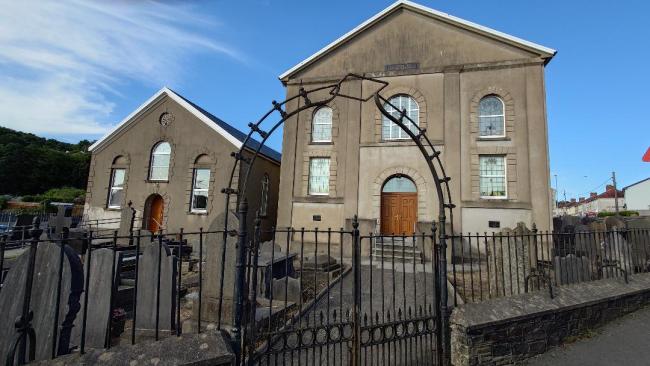
Thus did The Reverend Herman Jones pay tribute – originally in Welsh – to the builders of the Jerusalem Independent Chapel in Carmarthenshire, which dates back to 1812. Hundreds of worshippers filled its pews and balconies during the Industrial Revolution, when nearby Burry Port grew as it exported coal as far as the US and Chile.
But now, says deacon John Thomas, the cost of maintenance borne by the Welsh-speaking congregation of 40 (including recently a new roof, new windows, new front doors and a new organ) means that money “is going out all the time”. Two other chapels remain locally: one now a chapel of rest, the other running one service a month.
Each chapel and church offers their chapter in the Welsh told story of their nation. But the decades-long decline in religious observance has forced many congregations to rethink how they relate to their building and the community around them.
300 churches to close
Wales is home to 3,500 Christian places of worship – independent, Anglican, Catholic, Methodist, Baptist, United Reformed, Quaker and some new Evangelical churches. Yet nearly 200 churches have closed since 2015, and at least 300 more are predicted to close in the next decade. Redundant chapels and churches are sometimes sold to a new congregation, but more often they are sold off for redevelopment, their role in the community lost and any interior craftsmanship hidden from public view or stripped out.
"It’s the biggest crisis since the Dissolution of the Monasteries in terms of the potential loss of this massive, extended collection of architecture and art, from stained glass and textiles to sculptural art and monuments,” says Chris Catling, Chief Executive of the Royal Commission on the Ancient and Historical Monuments of Wales.
In addition, congregations not at imminent risk of closure may still need help to maintain an ageing building, especially as climate change brings wetter winters. Access to grants for repairs has been squeezed, notably by the scaling back this year of the UK Government’s Listed Places of Worship Grant Scheme, and deep cuts to the Welsh Government’s 2024-25 culture budget.
Halting the loss of Wales’ built religious heritage requires imaginative thinking. With £1.9m from The National Lottery Heritage Fund, in 2023 the National Churches Trust launched its three year Cherish project which covers Wales, as well as Scotland and the North West of England. The project offers grants, advice and ideas to churches and chapels in Wales and encourages them to increase their visibility by opening their doors to visitors.
In 2024 the Cherish project has supported 18 churches and chapels to carry out repairs and project development. The National Churches Trust also provides funding for work in Wales through its other funds and through support from other trusts and individuals particularly invested in the nation’s ecclesiastical built heritage. This has included a grant of £30,000 to Bryn Sion Baptist Fellowship Chapel in Aberdare, Wales, which is set to re-open after having been forced to close due to structural problems.
Promoting heritage
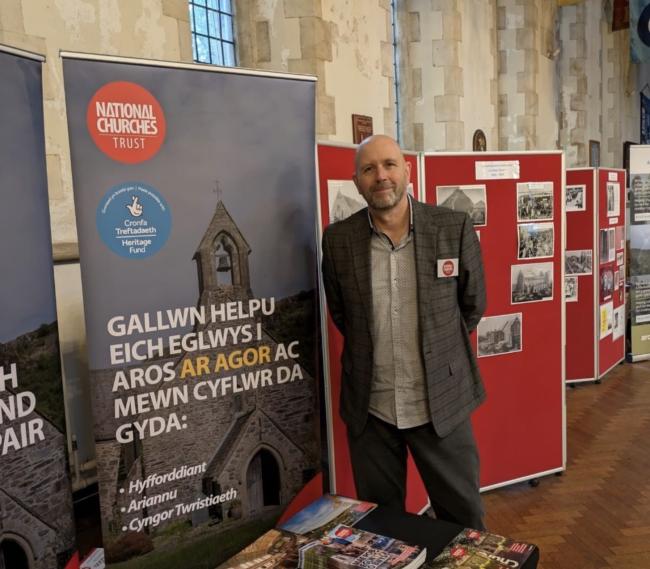
Gareth Simpson, the National Churches Trust’s Welsh-speaking Cherish Support Officer, is on hand to offer advice and ideas, visiting applicants and connecting them to specialist architects. He also attends events and meetings discussing regeneration, to promote the heritage offer of
churches as part of the town and high street landscape.
"Buildings need people, whether of faith or not, to thrive,” he stresses. He notes that many places of worship host food banks and warm spaces and make spaces available for community hire. He also helps them consider avenues such as social enterprise or permanent commercial tenants for any underused premises.
At Jerusalem Independent Chapel, a £10,000 Cherish grant paid for new rendering and the strengthening of the arches that top its tall windows. Now the work is complete, they are planning to open their doors to visitors, such as those who come to pay their respects to Mary Poppins star Glynis Johns, whose ashes are interred in the cemetery.
The grant also left the congregation able to afford to fund repairs to the vestry that enabled them to welcome in more paying local groups. The chapel teamed up with a new heritage group to put on a local history evening. This attracted 100 people and raised £250, and the group is planning a new walking tour that will include Burry Port’s three chapels.
Bastions of Welsh language
Most grant applications come from the (Anglican) Church in Wales, which has the most churches, many of them listed; increasingly, Methodist churches are reaching out; by contrast the majority of Catholic dioceses have development teams that manage the needs of their church buildings well.
The independent non-conformist chapels are under-represented among applications – but could not have greater cultural significance, Gareth Simpson says.
"These chapels are part of the nation’s built heritage,” he explains; "they became 'bastions' of the Welsh language during the Victorian era, when Westminster officials insisted on education in English. It’s down to chapel culture, arguably, that we still have the language today."
The National Churches Trust also encourages churches to open their doors to tourists, and more than 500 Welsh churches, chapels and cathedrals are signed up to its Explore Churches webpages.
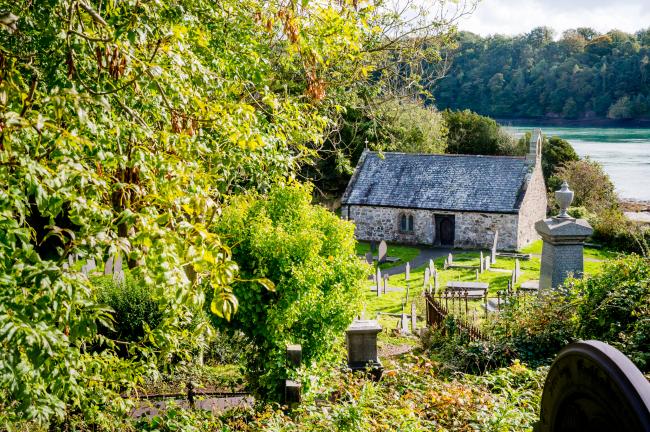
In 2021 the National Churches Trust teamed up with Visit Wales for the Experiencing Sacred Wales project to highlight some of the country’s most stunning and under-celebrated places of worship: from rugged coastal chapels founded by fifth-century saints, to ornately carved cathedral interiors to tree-covered holy wells – and St Trillo, Rhos on Sea, a six-seater church believed to be Britain’s smallest.
Churches and chapels opening their doors to visitors is “absolutely vital”, adds Catling. Where chapels have done so, they “have been surprised by the warmth of the reaction of local people who’ve passed the building every day of their lives.” Some have also received members of the Welsh diaspora studying their family history, he adds.
Claire Walker, Chief Executive of the National Churches Trust sees the future of the churches and chapels of Wales as a real opportunity that is there for the taking: “We’re asking people to embrace the fantastic heritage that’s part of the DNA of Wales. The churches belong to us all. There’s something for everybody, whether they’re of any religion or none, as a space for visiting, a nice day out, contemplation, solace, meeting friends, worship if you want – and anything in between, as long as the door is open.”
A version of this article was published in our 2025 Annual Review and was written by Abigail Frymann Rouch. Abigail is a religious affairs journalist and regularly writes for The Times, The Church Times and The Tablet, where she was foreign editor, then online editor. She has also written for The Telegraph, The Guardian, The Independent, The Critic, BBC Music Magazine, Commonweal and Deutsche Welle among others
