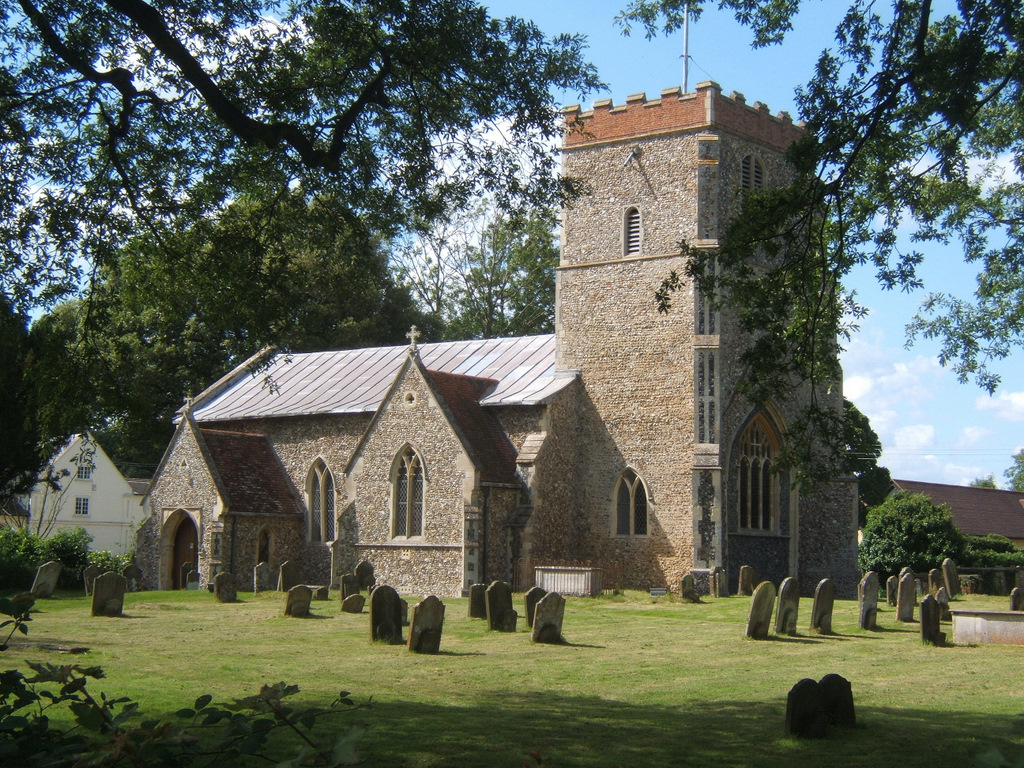
St Mary's is at first glance a traditional Suffolk village church but look a little closer and there are several surprises. Most unusually, the tower is at the east end of the building, a result of the destruction of the chancel in the 1700s. In the past there was a chancel that was situated to the east as well as the west but it collapsed and very little can be seen nowadays.
Its wide nave is spanned by a shallow arch-braced roof and the base of the tower serves as the chancel. The 18th century communion rails have twisted balusters and fluted gate-posts. The pulpit dates from the mid-17th century and rises from a short stem of bunched scrolls. There are flattened acanthus scrolls at the angles and it was constructed using older materials. The pulpit is believed to be the tallest in the county and tests the mettle of any visiting preachers.
The large 19th century window may have been inserted in the eastern arch when the collapsed east chancel was removed. The highly coloured window glass is by Albert Moore. The churchyard has several interesting stones, and also a striking statute of Hope that marks the entrance to the Walford family vault.
Dallinghoo is also the birthplace of Francis Light, the founder of Penang, Malaysia, and father of William Light, the founder of Adelaide, Australia. Although local legend suggests he lived at Dallinghoo Rectory, the only written connection to Dallinghoo can be found in the baptismal record of St Mary's.
The church sits around 200 people, has parking next to the church, by the village hall, and has both a kitchen and toilet facilities.