
St Uny
Lelant, Cornwall
There is no record of first consecration but there is documentary evidence that in 1170 Thomas Beckett confirmed income to the Priory of Tywardreath.

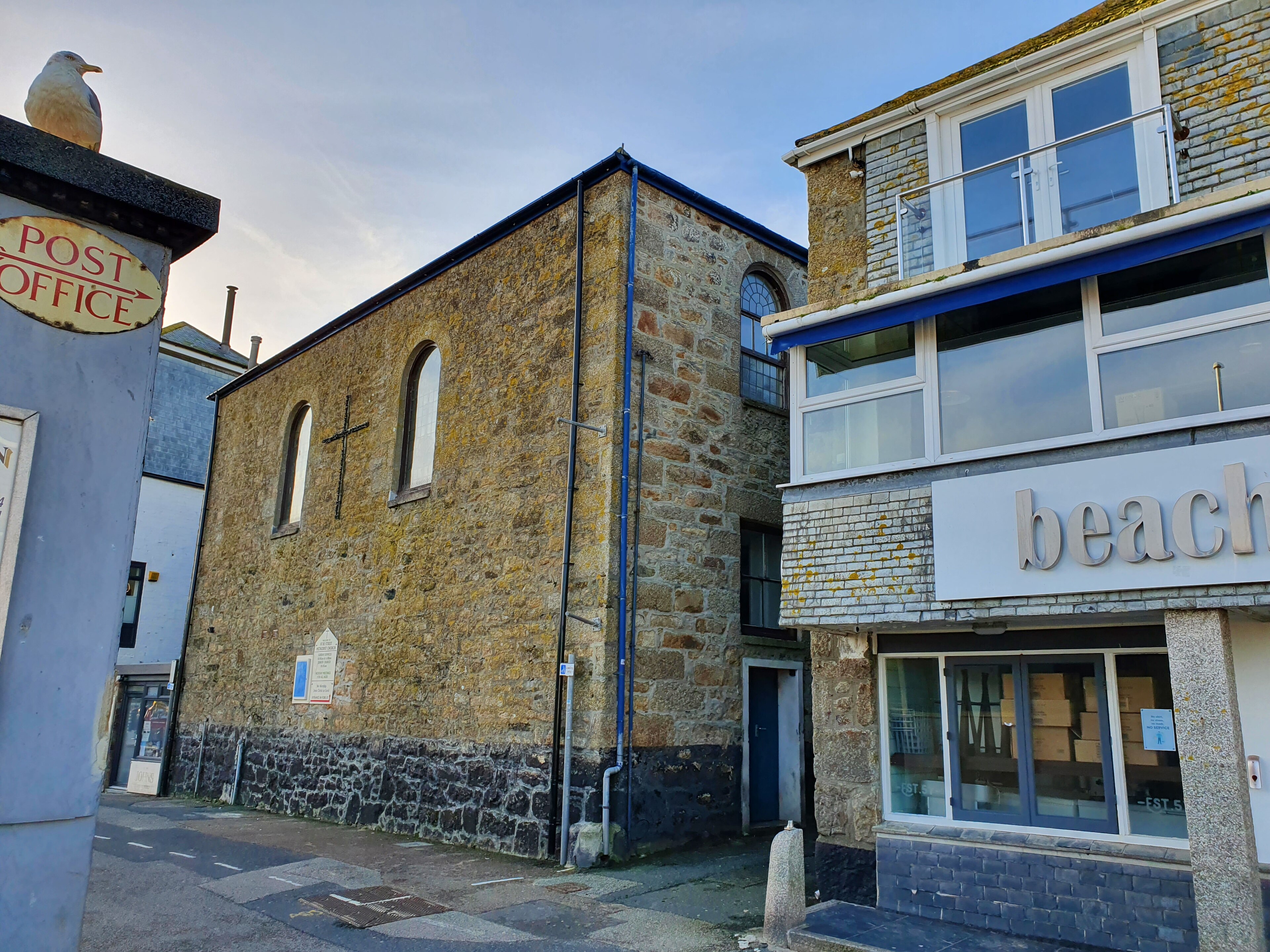
The 'Fishermen's Chapel' with a story bound up in the life of this community is a great example of a Cornish Methodist Church with a unique history.
St Ives, Cornwall
The building itself, now nearing 200 years since its inauguration and continuance of its original purpose as a Primitive* Methodist Chapel, has a prime location on the seafront at St.Ives. This grade 11 listed building built in 1831 Overlooks the harbour at its eastern border and fronts onto the town's busiest shopping precinct. The exterior of the building is simple in its exterior appearance as like most non-conformist churches of its generation the building was functional with little outward adornment or decoration such as a steeple, tower or bell as this was deemed unnecessary nor essential to the act of worship therein.
Behind the simple and restrained exterior lies a history that is unique.
Following his first visit to the town by the evangelist Joseph Grieves in 1829 the people promised him a place to preach. The site where the chapel was to be built was at that time jointly occupied by a blacksmith's shop, owned by a Mr Hart, and an orchard, owned by a Captain Stevens. Both gentlemen agreed to release the land for a chapel to be built there. It was Mr Hart's intention to build a new Smithy across the road and vacate the site, but the Council at that time refused permission for a new build on the sea front. Undaunted, the intrepid Mr Hart built a new shop inside his existing shop and moved it across the road on rollers, thereby vacating the land and providing it for the chapel. The smithy no longer exists but it's location is remembered locally as "Hart's Shop".
In the 1800s St.Ives was primarily a fishing port whose economy was almost totally dependent upon the fishing and mining industries. The lower part of the town included the cottages where the fisher folk and lived and their fishing boats were instrumental in carrying the building stones from the quarry, 5 miles down the coast, to the harbour where they were subsequently carried by the wives and other ladies to the building site in their "pinnies" (aprons). Tradition has it that the building work was overseen & undertaken a Mr Richard James at a cost of £830 1s 1p.
The building was dedicated to the glory of God in 1831 by Joseph Grieves, as promised in 1829.. The Rev William Booth (later General Booth, founder of the Salvation Army) led a revivalist campaign in the town and preached at the Primitive Methodist 'Ebenezer' Chapel several times between September 1861 & January 1862.
The noted artist Mr WHY Titcomb visited this chapel and recorded a Sunday School Service and a prayer meeting in charcoal medium. These large drawings are on display in the chapel today and are a regular "draw" for visitors coming to our town to explore our art heritage. The paintings have been exhibited in the Royal Academy, in Paris and at the Chicago World's Fair; currently on display in the Dudley art gallery. Mr Titcomb wrote a letter (also framed & displayed within the sanctuary), explaining the background to his drawings which includes one scene of a sick lady in her bed surrounded by the chapel elders praying for her. The lady recovered and Titcomb requested that the characters sat to recreate the scene so he could draw it. This picture is also displayed in the sanctuary and some of the characters portrayed are relatives of our fellowship members today.
Lelant, Cornwall
There is no record of first consecration but there is documentary evidence that in 1170 Thomas Beckett confirmed income to the Priory of Tywardreath.
Phillack, Cornwall
Above the porch door is a chiro stone lozenge found on site in the 1860s which dates from 350-400AD, the Christian faith has been here for more than 1600 years!
Hayle, Cornwall
St Elwyn is located next to the estuary of Hayle near to three miles of golden sand and it has an imposing presence above the town.