
The Ascension
Hall Green, West Midlands
As one of the only Queen Anne style churches left in Birmingham, the church was founded by Job Marston, a local philanthropist, has a rich and varied history.

A welcoming community in the heart of Stirchley where people explore faith together, build genuine friendships, and seek to bring hope to the neighbourhood.
Stirchley, West Midlands
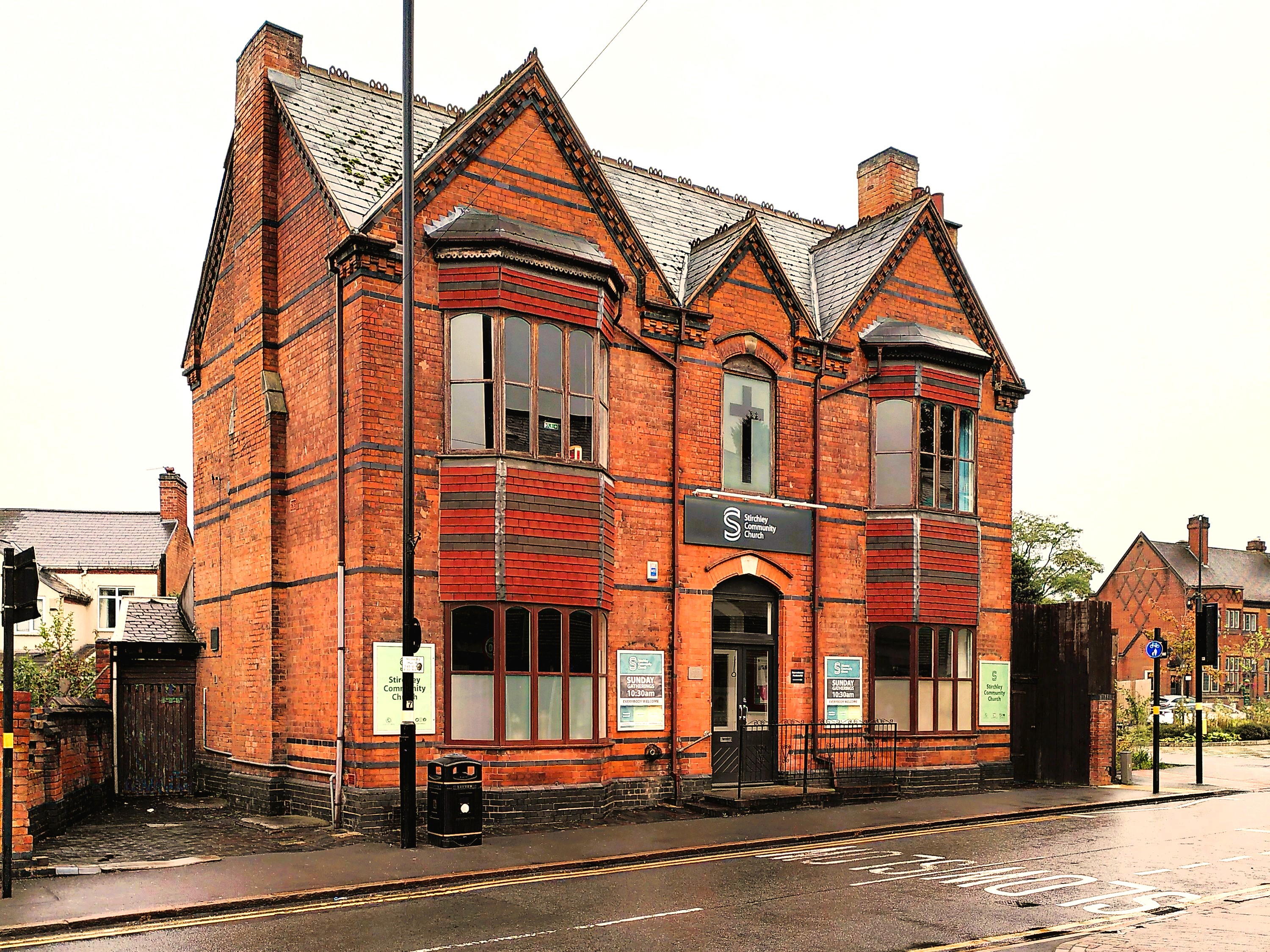
Stirchley Community Church occupies one of Stirchley’s most distinctive late Victorian civic-religious buildings: a former Cadbury-funded institute and Friends meeting house opened in 1892 as the Stirchley Institute. It was built during the period when Richard Cadbury and George Cadbury were shaping much of local social infrastructure, so the architecture reflects that practical Quaker ideal - solid, restrained, and community focused rather than overtly decorative.
Architecturally, the building is red brick, late Victorian, and institutional in character, with a broad street frontage and a symmetrical, functional composition rather than the vertical emphasis of a Gothic church. Instead of a spire or tower, its exterior reads more like a civic hall: large rectangular windows, simple brick detailing, and a strong horizontal form designed to accommodate multiple public uses. This is typical of late 19th century Quaker and philanthropic buildings, where usefulness and dignity mattered more than ornament.
One of its most notable internal features is the large first-floor hall, originally intended for lectures, meetings, worship, and social events. That room still retains a maple floor, an unusual survival that points to its former use for dancing and public gatherings. The scale of the upper hall gives the building a spacious interior uncommon in smaller suburban churches, with high ceilings and a broad uninterrupted floor area more reminiscent of an assembly room than a conventional nave.
The interior furnishings today are relatively simple because the building has been repeatedly adapted over more than a century. Historically it included spaces for tea rooms, educational classes, a snooker room, and even an early cinema, so the plan is compartmentalised rather than arranged around a single liturgical axis. Modern church use has added practical features such as a lift for first-floor access, updated lighting, and flexible seating rather than fixed pews, reflecting its continuing community role.
Unlike purpose built Anglican churches of the same date, it has little ecclesiastical ornament - no elaborate stained-glass programme, carved stone chancel, or heavy liturgical furniture. Its character comes instead from its surviving institutional proportions, timber flooring, brickwork, and adaptable internal rooms, all of which still reveal its original identity as a late Victorian social institute designed to serve the neighbourhood as much as worshippers.
Hall Green, West Midlands
As one of the only Queen Anne style churches left in Birmingham, the church was founded by Job Marston, a local philanthropist, has a rich and varied history.
Kings Heath, West Midlands
Welcome to All Saints, Kings Heath, your parish church in the Diocese of Birmingham!
Kings Norton, West Midlands
The Cotteridge Church is an Anglican, Methodist and United Reformed Church Local Ecumenical Project in South Birmingham and is a busy seven day a week church well known in the area as the heart of the community.