

When roof repairs were completed on St John’s Church, Fivemiletown in County Tyrone, Northern Ireland, the congregation thought they could stop worrying about their 300-year-old building. After all, they had already had the sandstone cladding and some of the pillars in the windows replaced. But two years later a leak has emerged around the lead flashing on the roof that has brought down a chunk of ceiling, rendering one room unusable. At stake is the stability of the church’s bell tower.
“We’re fumbling in the dark trying to find somebody to do the work,” says Alywin Barton, Chair of the church’s Glebes Committee. “It’s who knows who, and there is no network, there’s no structure to find these people.”
The National Churches Trust has supported the church with funding and advice for a number of years. “We often get churches informing us of delays due to the inability to source labour or contractors,” says Kerry Rooney MBE, the National Churches Trust’s Support Officer for Northern Ireland. Old buildings may have unexpected quirks, but delays to a project to address them can have knock-on effects such as rising costs and further deterioration to the building.

“Gone are the days when congregations had the resources among themselves to care for their own buildings”, says one of the National Churches Trust’s Support Officers for Scotland, David Lynch. He says smaller congregations, ageing buildings and stricter building regulations mean outside help is needed.
Finding specialist contractors is a challenge, especially for the church or chapel in the hills or several boat journeys away from city-based firms.
There is no shortage of need: across England, Wales/Cymru and Scotland in addition to some 35,000 churches, there are around 6.5 million pre-1919 buildings.
Even ruins such as the once-majestic St Andrew’s Cathedral in Scotland need regular inspections by experts in heritage stonework to keep visitors safe.
Dangerously short supply
Yet, according to several measures, the people working in the heritage skills that keep older churches safe and sound are in dangerously short supply, and many of the training routes by which the next generation should have entered have closed. A 2024 Historic England report identified shortages in trades such as lime plastering, stonemasonry, heritage carpentry and heritage glasswork, and that the workforce contained “relatively fewer workers aged 35 or under”.
Andrew Wood, a former president of the Ecclesiastical Architects & Surveyors Association, counts more than a dozen skills important for churches on the Red List, a biennial inventory of endangered crafts published by the Heritage Crafts charity.
Among these are bell-founding, organ-building, gauged brickwork and historic stained-glass window making.
Rather worryingly, there may soon be a shortage of church architects. “Conservation architects who specialise in church architecture are also declining in numbers as the ‘old guard’ retire,” he says. Those coming on are finding that there is less and less money in it, so junior architects are not encouraged to specialise in churches.
In recent years, financial support for people wanting to enter these areas has been reduced, leaving more of the training costs with employers: grants from the industry body, the Construction Industry Training Board, have been squeezed, and UK Government funding for the NVQ Level 3 in Heritage Construction ended last year.
Training schemes
However, important initiatives have been launched to address these shortages. Historic England’s five-year Heritage Building Skills Programme, which ends this year, has provided placements for 42 trainees at 30 construction firms and employers across the North of England. Historic England's new strategic plan pledges to “increase the supply of heritage construction skills” but no detail has yet been announced.
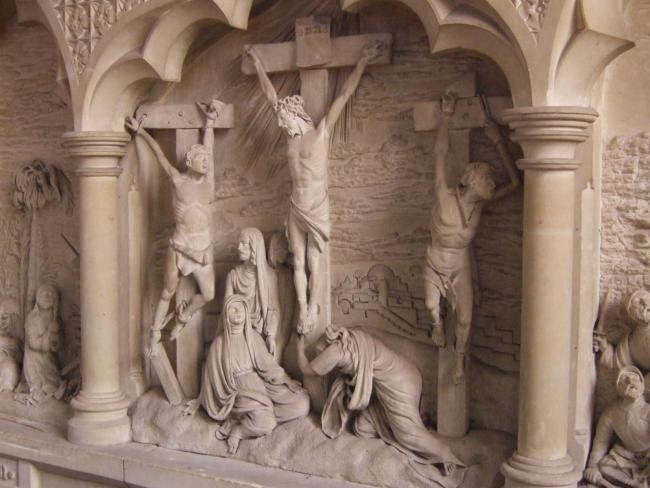
Two of the most established training schemes are the Cathedrals Workshop Fellowship’s Foundation Certificates and Foundation degrees, from which 87 students have graduated in the last 17 years and on which 20-25 students are currently enrolled. Students train in heritage crafts at 14 Church of England cathedrals in areas such as architecture and archaeology, conservation and stonemasonry. This benefits “the whole heritage profession,” says Cathedrals Workshop Fellowship's Executive Director Michael Sheppard, including churches situated near cathedrals.
Northern Ireland’s Construction Industry Training Board researched the heritage skills shortage in 2018 and since then has run various projects promoting traditional building skills, including the All Ireland Heritage Skills Programme for eight early career craftspeople in partnership with The King’s Foundation, and a collaboration this year led by National Museums NI that will train a further 32 people.
Meanwhile a three-year Stained Glass Craftsperson Apprenticeship is in its second year, which Steve Clare MBE ACR, founder and director of Holy Well Glass studio and a fellow and former chairman of the British Society of Master Glass Painters (BSMGP), has helped to develop. It is a collaboration between, industry professionals, the Worshipful Company of Glaziers and Swansea College of Art at University of Wales Trinity St David. The apprenticeship is largely government-funded but the Glaziers, the BSMGP and the Church Buildings Council are helping cover students’ additional costs.
Conservation grants
The Church of England is playing its part to support the crafts on which much of its estate depends. Last year its conservation grants team were able to more than double the grants they awarded, thanks to nearly £5 million over the next five years from The National Lottery Heritage Fund.
One grant helped pay for students in Wall Painting Conservation at London’s Courtauld Institute of Art to assess century-old murals in the Lady Chapel of St Jude’s Church in Hampstead Garden Suburb in London.
The Rev Emily Kolltveit, Vicar of St Jude’s, said: “Wall paintings often suffer from environmental damage, previous restorations, and natural aging. At St Jude's, the teams faced issues like flaking paint and weakened plaster. Instead of rushing repairs, they tested various consolidation methods to find the gentlest and most effective solutions.”
“The work at St Jude's is more than a restoration project; it is a commitment to cultural heritage. By preserving these wall paintings, the teams protect a piece of history that tells stories about the community, art, and craftsmanship of the past.”
Organ repairs
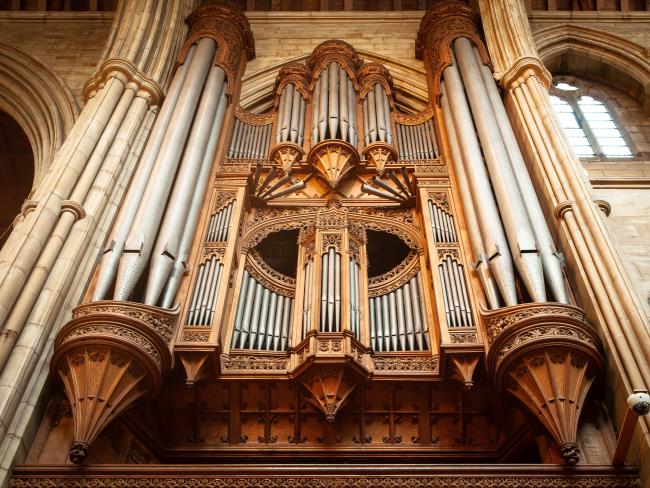
Of course, some heritage skills shortages can be addressed with relatively small amounts of training. Organ-building is another Red-Listed craft.
The 'Pipe Up for Pipe Organs' charity, trains volunteers in the basics of repairing and dismantling, moving and re-installing organs no longer wanted in their original home. It has also identified that some instruments fall silent for want of minor repairs, so it funds up to three days’ repair work by a professional to restore them to use, explains co-founder Martin Renshaw.
Pro-active maintenance
In addition to needing more people with specialist skills to deal with specific issues, keeping a church building in good condition also requires a pro-active approach to more general maintenance.
That a stitch (or a roof tile) in time saves nine is central to the thinking of the Church of Scotland as it addresses several financial crises. Its General Trustees have appointed 12 Presbytery Buildings Officers to carry out Quinquennial Surveys of churches in-house and provide expert advice so congregations can repair their buildings “in a more kind of pragmatic, cost-effective way”.
One Presbytery Buildings Officer, Jamie McNamara, is piloting a proactive maintenance scheme in Perth to help ensure buildings are kept in good condition and that issues are spotted quickly. Jobs such as clearing out gutters are carried out every six months (not once “in a generation,” which McNamara has seen).
“Maintenance is the core of good building husbandry,” he stresses. “If you got your maintenance sorted out, you’re halfway there.”
Any shortage of people with the heritage skills needed to care for the UK’s church buildings puts their future at risk. The new initiatives in promoting tuition and upskilling are a welcome step, and will benefit churches and cathedrals across the UK as well as those to whom they minister, not to mention the nation’s wider heritage sector and all who enjoy it.
Fragmented market
However some believe that the crisis in heritage skills may not be all it seems and that the problem lies in a very fragmented market and the fact that many churches are in remote areas. According to Stone carver Alex Wenham: “The people who talk the loudest about skill shortages tend to come from client side,” but he is not short of work and he has recently taken on an apprentice who graduated in fine art before studying at the respected King’s Foundation. “The system is not perfect,” he reflects – jobs in Wales or the Highlands are too far away for him – but he also believes “there’s not very good information exchange.”
Directories, such as the Building Conservation Directory, that produced by ICON, the Institute of Conservation and the National Churches Trust’s Specialist Skills Directory list firms with expertise in many heritage disciplines. However, they cannot make up for a shortage of heritage specialists in more remote areas and especially in parts of Scotland, Wales and Northern Ireland.
Training schemes for these areas, and support for existing firms to take on apprentices, are vital if the skills needed to maintain places of worship throughout the UK are to survive.
And this is very much work with a long-term future, which will not easily be supplanted by AI, even if though this new technology is helping to make some aspects of conservation easier. Stonemason Tom Francis, a Cathedrals Workshops' alumnus, notes: “Not many people seem to be willing to get dirty for a living,” but he adds: “You’ve got a job for life if you learn the stone industry… I’m more than willing to teach anybody who really wants to learn.”
A version of this article was published in our 2026 Annual Review and was written by Abigail Frymann Rouch. Abigail is a religious affairs journalist and regularly writes for The Times, The Church Times and The Tablet, where she was foreign editor, then online editor. She has also written for The Telegraph, The Guardian, The Independent, The Critic, BBC Music Magazine, Commonweal and Deutsche Welle among others.
